Hormone Replacement Therapy Educational Event
Learn More About Hormone Health, Wellness, and HRT Options
Join Prime Youth Aesthetics for an informative evening dedicated to understanding Hormone Replacement Therapy (HRT) and how it may support your wellness goals.
We’re doing things a little differently this time — instead of a traditional presentation, we’re bringing our community together for an educational experience featuring valuable information, meaningful conversations, and dinner at a local restaurant.
Date & Location Details Coming Soon
Experience clarity, relief, and meaningful change
If you are still struggling and other treatments haven’t given you the results you hoped for, ketamine therapy may offer a new direction. By enhancing neuroplasticity, your brain can create new pathways for healing.
Starting at $750
Take the first step toward healing → Call our office to see if you’re a candidate
What You’ll Learn
During this educational event, you’ll have the opportunity to learn more about:
How hormones can impact overall wellness
Common signs of hormone imbalancens of hormone imbalanc
Available HRT options and considerations
Questions to discuss with a healthcare provider
How personalized wellness approaches may support your goals
RESERVE YOUR INTEREST
We’re currently gathering interest for this upcoming event. Join our interest list to receive updates about the date, location, and event details.
Bring Someone With You
Know someone who may benefit from learning more about Hormone Replacement Therapy?
Share this event with a friend or family member who may be interested.
Ketamine for addiction management
Substance use disorders (addiction) whether to alcohol, cocaine, opioids, cannabis, or other drugs, involve powerful neural pathways that reinforce cravings, habitual use, and relapse. Traditional treatments (therapy, medications, behavioral support) help many people, but some individuals don’t respond fully or continue to struggle with cravings and relapse. That’s where research on ketamine as an adjunctive treatment is emerging. Ketamine is not a first-line or stand-alone treatment for addiction, but early research suggests it may help when integrated with therapy and support in a clinical setting. Research so far suggests it can reduce cravings, support abstinence, and help with withdrawal symptoms in conditions like alcohol, cocaine, opioids, and cannabis use disorders. However, evidence is still preliminary, and ketamine treatment should be considered within a comprehensive, medically supervised care plan.
How Ketamine Might Help in Addiction
-
Reducing Cravings and Use
Preliminary studies show that ketamine may:
- Decrease cravings for substances such as alcohol and cocaine.
- Increase abstinence rates or duration of abstinence when administered in controlled clinical settings, especially with supportive therapy.
For example, research suggests that ketamine infusion combined with psychotherapy can lead to:
- longer time to relapse
- fewer heavy drinking days
- greater likelihood of sustained abstinence in people with Alcohol Use Disorder (AUD).
-
Supporting Withdrawal Management
In alcohol withdrawal, ketamine has been studied as an adjunct to standard care and may:
- reduce severity of withdrawal symptoms
- decrease reliance on benzodiazepines in some difficult cases
However, more clinical trials are needed before definitive recommendations can be made.
-
Enhancing Therapy Engagement
Ketamine may temporarily increase neuroplasticity, the brain’s ability to reorganize and form new connections which can help people engage more deeply with psychotherapeutic interventions like motivational enhancement therapy or relapse prevention work.
This potential “window of enhanced learning” is an active area of research, and combining ketamine with structured therapy appears to yield better outcomes than ketamine alone in many studies.
Alcohol Use Disorder (AUD)
- Ketamine has been linked with:
- reduced alcohol consumption
- increased abstinence duration
- reduced cravings, particularly when combined with psychotherapy.
- Some studies report earlier resolution of severe withdrawal symptoms (e.g., delirium tremens) when ketamine is used as an adjunct with standard treatment, though more research is needed.
- Articles:
- Ketamine Treatment for Alcohol Use Disorder: A Systematic Review — Ketamine may help reduce alcohol use and cravings. https://pubmed.ncbi.nlm.nih.gov/37273364/
- Scoping Review: Ketamine in AUD and Withdrawal — promising but requires more evidence. https://pubmed.ncbi.nlm.nih.gov/37181899/
- Review in European Psychiatry: Ketamine + therapy may prolong abstinence. https://www.cambridge.org/core/journals/european-psychiatry/article/keta mine-treatment-for-alcohol-use-disorder-a-review/5D3403855E6D45C36 CD8318FEABB95C9?utm_source=
Opioid Use Disorder (OUD)
- Some small studies included in recent reviews show increased abstinence and reduced craving when ketamine is used within therapeutic protocols.
- Evidence is still limited by sample size and study design.
- Articles:
- Systematic review: Ketamine shows potential benefits across SUDs including opioids. https://pubmed.ncbi.nlm.nih.gov/40320049/
Cannabis Use Disorder (CNUD)
- Very limited data, but early results indicate ketamine may help reduce weekly cannabis use and increase confidence in abstinence in some participants.
- Articles:
- Ketamine’s effects in cannabis use disorder. https://pubmed.ncbi.nlm.nih.gov/40320049
Important Safety & Clinical Considerations
-
Not a Stand-Alone Treatment
Ketamine is not a replacement for evidence-based addiction treatments (like counseling, medication-assisted therapy, or support programs). It may be used as an adjunct under medical supervision.
-
Risk of Misuse & Monitoring
Ketamine itself has misuse potential outside a clinical setting, especially at higher, unsupervised doses and should be given by a medical provider in a setting with monitoring.
Therapeutic programs typically include psychotherapy and integration sessions to help translate insights into long-term behavior change.
Contact Us Today
Reach out to us if you want to know more, have any questions, concerns, or to schedule a consultation or service— we're here to assist you on your journey to renewed beauty!
A Guided Addition to Your Wellness Plan
Modern studies continue to examine how ketamine may influence brain networks involved in distressing or repetitive thought cycles. Because of these emerging insights, ketamine is used off-label as an adjunctive option—not a cure and not a replacement for comprehensive care. At Prime Youth Aesthetics, ketamine infusions are administered intravenously in a structured, medically supervised setting designed to support individuals navigating persistent mood-related challenges or chronic pain symptoms with safety, clarity, and compassion.
How It Works
What does Ketamine do to your brain?
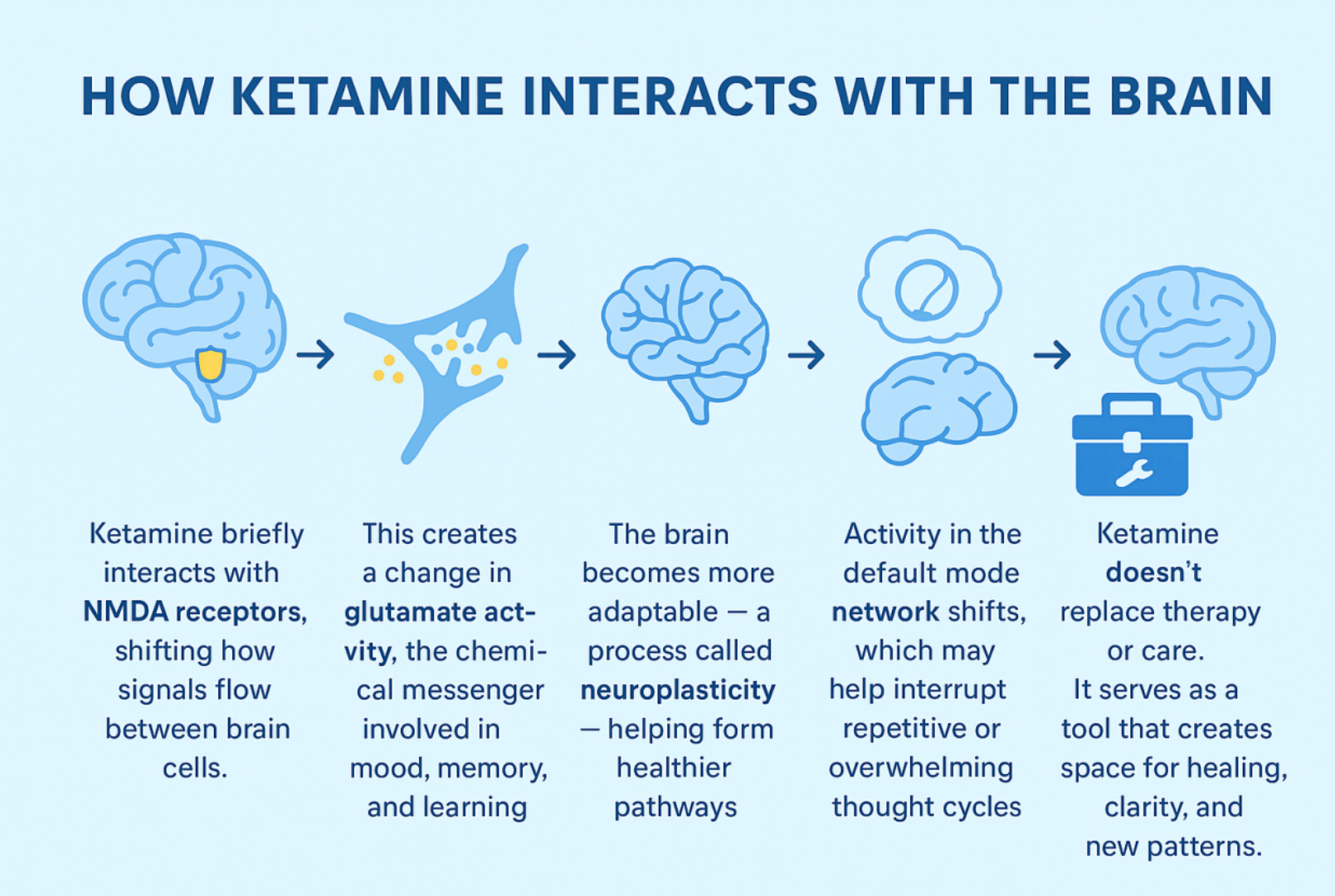
Ketamine interacts with a system in the brain called the NMDA receptor, which plays a role in how your brain cells communicate. By briefly blocking this receptor, ketamine creates a shift in how the brain uses glutamate, a chemical that helps with learning, memory, and emotional processing. This shift can encourage the brain to become more flexible, making it easier to form healthier patterns, break out of unhelpful thought cycles, and respond differently to stress.
Ketamine interacts with a system in the brain called the NMDA receptor, which plays a role in how your brain cells communicate. By briefly blocking this receptor, ketamine creates a shift in how the brain uses glutamate, a chemical that helps with learning, memory, and emotional processing. This shift can encourage the brain to become more flexible, making it easier to form healthier patterns, break out of unhelpful thought cycles, and respond differently to stress.
Overall, ketamine acts as a tool that helps create a window of opportunity for emotional healing, new habits, or supportive therapies to work more effectively.